
John Locke Essay Competition
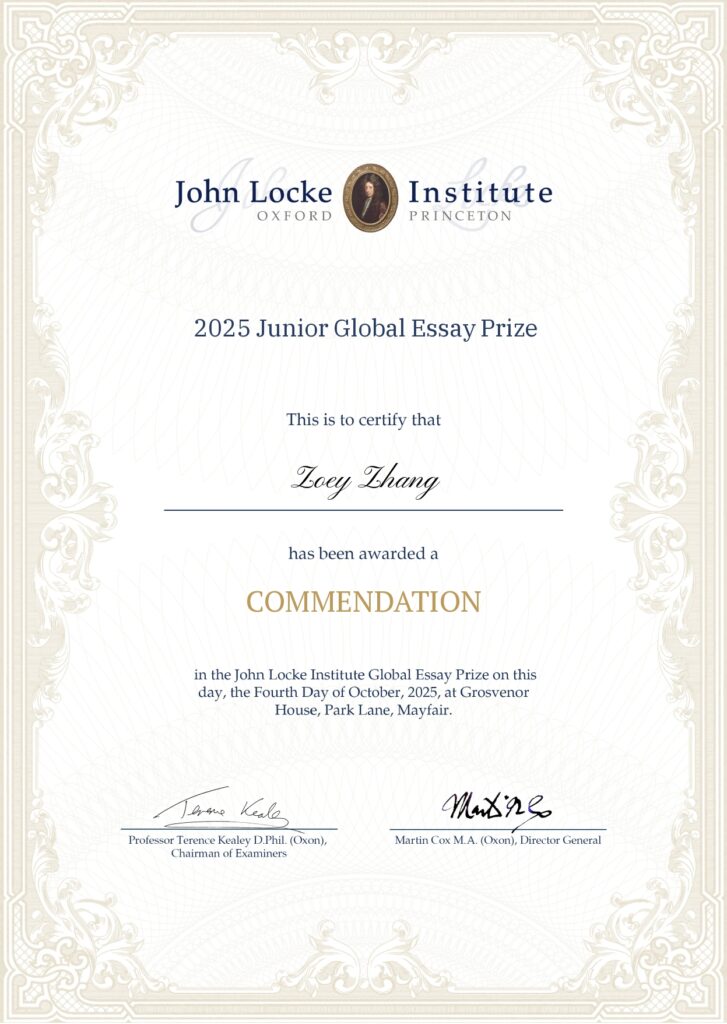
John Locke Institute, 2025 Junior Global Essay Prize, Commendation Award
Why Do People Become More Boring as They Grow Up and Grow Older?
It is a situation that every young adult finds themselves in at least once: you are sitting at a family dinner, swinging your legs under the table, trying not to fall asleep while your uncle explains the subtle differences between two spreadsheets. Or worse, your mom and her cousins get deep into a thirty-minute breakdown of someone’s toddler’s picky eating habits. And all you can think is: Is this what adulthood is like?
Adults love to talk about their jobs, their kids, and vaguely reference their back pain, all while carefully avoiding saying anything spontaneous, adventurous, or wildly imaginative. Evan Anderson captures this feeling perfectly when he writes, “I remember thinking, ‘When I’m an adult, I’m going to be the most fun and awesome adult ever.’“1
Why do people get so much more monotonous as they grow older? Could it be societal pressure and the soul-squashing structure of school and work? Do adults lose their sense of curiosity as they grow older? Is there a neurological effect that contributes to this? In this essay, I will argue that the pressure to conform to social expectations and professional norms, alongside loss of curiosity and neurological changes are the factors that contribute the most to this slow fade into adulthood dullness, leaving behind people who talk, but do not really live.
1. The Social Expectations in Adult Work Life Leave No Place for Self-Expression
As people grow older, they tend to become less expressive, less spontaneous, and overall less imaginative. Society slowly pressures them to trade authenticity for acceptability. In contrast, in adolescence, finding their authenticity is the pressure. As Marissa Totaro, one of the staff writers of the Huntingtown High School News Site in Maryland put it, “You have to worry about academics, friends, family, jobs in some cases, figuring out what you will do after high school, what career you want to have for the rest of your life…oh and figuring out exactly who you are.”2 The pressure for self-exploration is immense and, as a result, adolescents will ask questions, make mistakes, and express themselves through fashion, music, art, and making their voices heard. There is an understanding that they are still figuring things out, and with that comes a kind of freedom.
As people grow older however, that freedom begins to shrink. Society stops expecting exploration and starts demanding stability. Everything that was connected to “figuring out exactly who you are” is now viewed as a distraction from being a productive, polished adult. There, the contradiction sharpens: “Employees might feel pressured to present a sanitised version of themselves that aligns with the brand’s idealised image rather than their true personalities.”3 Companies impose rigid behavioural standards, creating a gap between being real and being professional.
As a result, adults feel pressure to “keep up with the Jones’” and may “purchase items [they] cannot afford to maintain an image that fits into [their] work, social, or neighbourhood environment.”4 Emotional labour piles on top of this as workers are expected to manage their feelings in customer service roles, leading to exhaustion. All of this happens while adults try to navigate a work-life balance where “deadlines to meet targets, financial obligations, and pressing family responsibilities” leave little space for joy or self-expression.5
The disappointment of not fulfilling these expectations, both external and internal, can leave people disconnected from who they once were. Over time, the spark that lit up childhood curiosity and creativity dims beneath the weight of responsibilities and routines. And so, for many, growing older becomes less about becoming more themselves and more about fitting into a version of adulthood that no longer feels like home.
2. Adults Are Less Curious About the World Around Them
As the years pass, children gradually lose the curiosity and boldness that defines them at a young age. When we are young, we ask a multitude of questions, not because we are trying to get the right answer, but because we genuinely want to understand the world. One study by Susan Engel, author of The Hungry Mind, found that toddlers can ask over one hundred questions an hour; however, once kids start school, that number drops fast. In some classrooms, older kids go entire lessons without asking anything at all. Engel even described one moment when a teacher interrupted a student with, “Zoe, no questions now, please; it’s time for learning.”6 Over time, this message sticks. We learn to stay quiet, to follow the rules, and to avoid standing out.
As people grow older, they tend to become cautious, not only in what they do but also in what they say. This is partly because adults develop strong social filters: internal systems of self-censorship that push them to say what is appropriate rather than what is honest. The Peter Pan Center, a Massachusetts-based program for childhood development, explains that social filters help maintain relationships by encouraging people to think before they speak, especially in potentially sensitive situations.7
While social filters may reduce conflict and avoid awkward moments, it also discourages spontaneity and limits authentic self-expression. Adults may hold back unusual ideas or personal thoughts out of fear they might be judged, while kids are often praised for being imaginative or “thinking outside of the box.” This contrast is clearly illustrated in a 2020 study by psychologists Emily G. Liquin and Alison Gopnik. In a series of learning tasks, children were more willing than adults to choose uncertain or risky options, even if those options may result in failure. Adults, in comparison, were quicker to settle on what felt like the “right” or “safe” choice. The researchers concluded that children have a stronger drive to explore and learn through trial and error, showing a deep commitment to discovery that adults tend to lose.8
One reason for this shift is a concept called “future time perspective.” As people age, they become more aware that their time is limited. A study by Li Chu and colleagues found that adults who feel they have less time left are less likely to pursue open-ended experiences like exploring new interests or asking questions without clear answers. Instead, they focus on what feels urgent, familiar, or productive. In doing so, they may sacrifice curiosity and creativity for the illusion of control and efficiency.9 This slow retreat from openness does not just make people more boring; it makes them less engaged with the world around them.10
3. The Neurological Effects of Age
Beyond the myriad of social factors discuss thus far, there is in fact a physical reason why people seem to get less curious with age: our brains change as we grow. Children’s brains are naturally wired to explore and take risks. Alison Gopnik, in her article When Younger Learners Can Be Better, explains that younger brains are “intrinsically more flexible and exploratory,” while adults “know more and explore less.”11 Children are often better at discovering new and unusual ideas because their brains are still open to possibilities. However, as we age, our brains prioritize efficiency and order over open-ended exploration.
Research from the Society for Neuroscience describes how, during adolescence and into adulthood, brain networks shift from being locally organised, where nearby brain areas work together, to forming larger, more complex connections between distant regions.12 This helps adults solve familiar problems quickly but can also make their thinking more rigid and less adaptable to new situations. The Society for Neuroscience goes on to describe how adults develop what scientists call “crystallized intelligence,” which is the accumulation of knowledge and facts, while their “fluid intelligence,” or the ability to solve new problems and spot patterns, tends to decline after around age thirty.13
Changes in how nerves transmit signals between the brain and body also affect how adults respond to novel experiences, making new learning feel more difficult or less rewarding.14 As people age, white matter decreases, which slows down nerve impulse speed resulting in slower cognitive function. A reduction in grey matter lowers neuroplasticity, meaning it takes longer to learn or adapt to new information. Additionally, the brain becomes less sensitive to dopamine, the body’s reward hormone, reducing motivation to try new things.
The inevitable descent towards monotony is not just about the responsibilities piling up or the daily routines wearing us down. It is about the slow, steady pressure to fit into a mold where curiosity, spontaneity, and boldness are squeezed out to make room for social expectations and socially acceptable behaviour. As Evan Anderson said, many of us dreamed of being “the most fun and awesome adult ever,” but instead, we find ourselves stuck in predictable conversations and safe choices. The truth is, this is not an inevitable part of growing up; it is a pattern shaped by schools, workplaces, and society itself. Curiosity, once natural and joyful, is slowly suppressed by social, neurological, and institutional pressures. From the early silencing of children’s questions to the brain’s natural shift towards caution, every stage nudges us away from exploration and towards conformity. Even neurology contributes to this. As we age, the prefrontal cortex becomes more developed and dominant, increasing our tendency to avoid risks and prioritize caution over exploration. This excitement of doing something new starts to fade, pushing us towards routine rather than wonder, but curiosity still remains one of the most powerful forces for growth and joy.
As recent research shows, curiosity is not lost, it is just waiting to be reignited.15 If we make space for questions, take risks, and resist the urge to settle into dull routines, we can reclaim the boldness that made us interesting as kids. Growing older does not have to mean growing duller. Yes – it can mean growing wiser, but also more curious and alive than ever before.
Endnotes
- Anderson, Evan. “5 Reasons I Now Understand Why Grown Ups Are Boring And Ornery,” Thought.is, last accessed June 24, 2025, para. 3, https://thought.is/5-reasons-i-now-understand-why-grown-ups-are-boring-and-ornery/
- Totaro, Marissa. “Societal Pressures on Adolescents and Their Effects,” hhsnews, last accessed June 24, 2025, para. 1, https://hhsnews.net/5402/features/societal-pressures-on-adolescents-and-their-effects/
- Shaw, Ben. “The Paradox of Authenticity: Navigating the Tension Between Culture and Service,” LinkedIn, last modified July 1, 2024, para. 3, https://www.linkedin.com/pulse/paradox-authenticity-navigating-tension-between-culture-ben-shaw-gl7ee/
- Pugle, Michelle. “How Peer Pressure Affects All Ages,” verywellhealth, last modified February 13, 2024, para. 11, https://www.verywellhealth.com/peer-pressure-in-teen-and-adult-life-5323858
- Mensah, Aziz and Adjei, Nicholas Kofi. “Work-life balance and self-reported health among working adults in Europe: a gender and welfare state regime comparative analysis,” BMC Public Health 20, no. 1052 (2020)
- Engel, Susan. The Hungry Mind: The Origins of Curiosity in Childhood (Harvard University Press, 2015)
- The Peter Pan Center. “Thinking It vs. Saying It: Teaching Kids the Power of Social Filters,” last modified May 17, 2025, para. 4 and 7, https://peterpancenter.com/thinking-it-vs-saying-it-teaching-kids-the-power-of-social-filters/
- Liquin, Emily G. and Gopnik, Alison. “Children are more exploratory and learn more than adults in an approach-avoid task,” Cognition 218, (2022)
- Li Chu, Tsai Jeanne L and Fung, Helene H. “Association between age and intellectual curiosity: the mediating roles of future time perspective and importance of curiosity,” European Journal of Ageing 18, no. 1(2020): 45-53
- Liquin, Emily G. and Gopnik, Alison. “Children are more exploratory and learn more”
- Gopnik, Alison, Griffiths ,Thomas L and Lucas, Christopher G. “When Younger Learners Can Be Better (or at Least More Open-Minded) Than Older Ones,” Association for Psychological Science 24, no. 2 (2015): 87-92
- Wnuk, Alexis. “When the Brain Starts Adulting,” BrainFacts, last modified November 20, 2018, para. 3, https://www.sfn.org/sitecore/content/home/brainfacts2/thinking-sensing-and-behaving/aging/2018/when-the-brain-starts-adulting-112018
- BrainFacts. “When the Brain Starts Adulting,” para. 5
- Jean-Claude, Dreher et al. “Age-related changes in midbrain dopaminergic regulation of the human reward system,” Proceedings of the National Academy of Sciences of the United States of America 105, no. 39 (2008): 15109, doi: 10.1073/pnas.0802127105
- Harvard Business Review. “How to Strengthen Your Curiosity Muscle,” para. 5
Bibliography
Anderson, Evan. Thought.is. “5 Reasons I Now Understand Why Grown Ups Are Boring And Ornery.” Last accessed June 24, 2025. https://thought.is/5-reasons-i-now-understand-why-grown-ups-are-boring-and-ornery/
Berliner, Wendy. The Guardian. “‘Schools are killing curiosity’: why we need to stop telling children to shut up and learn.” Last modified January 28, 2020. https://www.theguardian.com/education/2020/jan/28/schools-killing-curiosity-learn
Bourdieu, Pierre. Distinction: A Social Critique of the Judgement of Taste. Translated by Richard Nice. Harvard University Press, 1984.
Buckley, Francis H.. The James G. Martin Center for Academic Renewal. “Curiosity Is Important, But Colleges Are Suppressing It?” Last modified May 14, 2021. https://jamesgmartin.center/2021/05/curiosity-is-important-but-colleges-are-suppressing-it/
Chamorro-Premuzic, Tomas. Harvard Business Review. “How to Strengthen Your Curiosity Muscle.” Last modified November 3, 2023. https://hbr.org/2023/11/how-to-strengthen-your-curiosity-muscle
Charles, Susan and Laura L Cartensen. 2010. “Social and Emotional Ageing.” Annual Review of Psychology 61: 383-409. doi: 10.1146/annurev.psych.093008.100448
Chu, Li, Jeanne L Tsai and Helene H Fung. 2020. “Association between age and intellectual curiosity: the mediating roles of future time perspective and importance of curiosity.” European Journal of Ageing 18, no. 1: 45-53. doi: 10.1007/s10433-020-00567-6
The Peter Pan Center. “Thinking It vs. Saying It: Teaching Kids the Power of Social Filters.” Last modified May 17, 2025. https://peterpancenter.com/thinking-it-vs-saying-it-teaching-kids-the-power-of-social-filters/
Dreher, Jean-Claude, Andreas Meyer-Lindenberg, Philip Kohn and Karen Faith Berman. 2008. “Age-related changes in midbrain dopaminergic regulation of the human reward system.” Proceedings of the National Academy of Sciences of the United States of America 105, no. 39: 15106-15111. doi: 10.1073/pnas.0802127105
Gopnik, Alison, Thomas L. Griffiths and Christopher G. Lucas. 2015. “When Younger Learners Can Be Better (or at Least More Open-Minded) Than Older Ones.” Association for Psychological Science 24, no. 2: 87-92. doi: 10.1177/0963721414556653
Gorvett, Zaria. BBC Future. “How your Personality Changes as you Age.” Last modified March 16, 2020. https://www.bbc.co.uk/future/article/20200313-how-your-personality-changes-as-you-age
Hamilton, Diane. Future Learn. “Four Factors that Diminish Human Curiosity.” Last accessed June 24, 2025. https://www.futurelearn.com/info/courses/developing-curiosity/0/steps/156501
Itani, Alaa, Isra Hasan, Lolya Younes, Ayman Alzaatreh. 2024. “Statistical analysis of the effect of socio‑political factors on individual life satisfaction.” Scientific Reports 14. doi: 10.1038/s41598-024-70067-5
Kidd, Celeste and Benjamin Y. Hayden. 2015. “The Psychology and Neuroscience of Curiosity.” Neuron 88, no. 3: 449-460. doi: 10.1016/j.neuron.2015.09.010
Liquin, Emily G. and Alison Gopnik. 2022. “Children are more exploratory and learn more than adults in an approach-avoid task.” Cognition 218. doi: 10.1016/j.cognition.2021.104940
MedlinePlus. “Aging changes in the nervous system.” Last modified July 15, 2024. https://medlineplus.gov/ency/article/004023.htm
Mensah, Aziz and Nicholas Kofi Adjei. 2020. “Work-life balance and self-reported health among working adults in Europe: a gender and welfare state regime comparative analysis.” BMC Public Health 20, no. 1052. doi: 10.1186/s12889-020-09139-w
Pugle, Michelle. Verywellhealth. “How Peer Pressure Affects All Ages.” Last modified February 13, 2024. https://www.verywellhealth.com/peer-pressure-in-teen-and-adult-life-5323858
Shaw, Ben. LinkedIn. “The Paradox of Authenticity: Navigating the Tension Between Culture and Service.” Last modified July 1, 2024. https://www.linkedin.com/pulse/paradox-authenticity-navigating-tension-between-culture-ben-shaw-gl7ee/
Totaro, Marissa. hhsnews. “Societal Pressures on Adolescents and Their Effects.” Last accessed June 24, 2025. https://hhsnews.net/5402/features/societal-pressures-on-adolescents-and-their-effects/
Wnuk, Alexis. BrainFacts. “When the Brain Starts Adulting.” Last modified November 20, 2018. https://www.sfn.org/sitecore/content/home/brainfacts2/thinking-sensing-and-behaving/aging/2018/when-the-brain-starts-adulting-112018